

When I started writing for this site I decided I needed an easily recognizable classification system so readers knew what they were getting into before they even started reading. It didn’t take long to settle on the system still in place today: an article is either a Short Take, Terminology, Overview, Timeline, or Deep Dive.
That worked pretty well until a couple months ago when I came up with an article that didn’t fit any of those headers—a piece that traced my thought process and research methodology to answer the question: did this guitar fragment come from an instrument smashed by Pete Townshend? Thus was born “Detective Stories”
But while I was working on my piece on the New Capris, another idea lodged itself into my brain. I wanted to follow it wherever it led. And so I did. And the farther I went, the more I realized that none of our categories—including Detective Stories—really fit.
So I’m introducing “Think Pieces.” Will it last? I don’t know. Does it feel appropriate? It does. So let’s get philosophical!
The very first modern Rickenbacker electric Spanish guitar was the Combo 600.
And every Rickenbacker since is also a Combo 600.
Well…not every single one, obviously, but most of them are.
Technically I could say every Rickenbacker is a Combo 600, a 4000, or a Forrest White—with a couple of oddballs thrown in. But the overwhelming majority of them are Combo 600s.
Don’t believe me? Let me prove it. In chronological order.
This is a Combo 600 (1954):

And this is a Combo 800 (1954):

But it’s really a Combo 600 with a humbucker pickup.
Here is a Combo 400 (1956):

But it’s really just a Combo 600 with a tulip top.
This is where I should probably stop for a minute and explain what I mean. Because obviously, that’s not a Combo 600.
Or is it? Ignore the upper half for a minute. Look at it from the waist down. Now compare it to a Combo 600.
Same outline.
Above the belt? Sure. That’s new.
Below the belt?
It’s a Combo 600.
Let’s continue.
Here’s an early 1957 1000:

That’s a short-scale Combo 400 with a slightly tweaked tulip top.
And a Combo 400 is really a Combo 600.
Here’s a 900 (1957):

That’s a 1000 with a slightly different treble cutaway and more frets, and a 1000 is a Combo 400 with a tweaked tulip top.
And a Combo 400 is really a Combo 600.
Here’s a 950 (1957):

A 950 is a 900 with two pickups. And as we’ve established above, a 900 is a 1000, which is in turn a Combo 400.
And a Combo 400 is really a Combo 600.
Let’s look at something completely different from all those short-scale solidbodies. This is a Combo 850 (1957).

But it’s really just a Combo 600 with a new upper cutaway.
Here’s an early 1957 Combo 450:

But it’s really a Combo 400 with an extra pickup.
And a Combo 400 is really a Combo 600.
Here’s a Combo 450 from later in 1957.

The upper cutaway was reshaped to improve access to the upper frets. But you already know that underneath it all it’s really a Combo 400.
And a Combo 400 is really a Combo 600.
1958 saw the introduction of the Capri line of semi-hollowbody guitars. The first of these were the short-bodied guitars, like this 325 Capri:

The 325 is really a short-scale, semi-hollowbody Combo 850 without a German carve.
And the Combo 850 is really a Combo 600.
Here’s a prototype 325 from 1958:

This prototype 325 is really a stretched-out production 325, which is really a Combo 850.
And a Combo 850 is really a Combo 600.
Here’s a full-size Capri from 1958, a 330 Capri:

At this point you’re probably going to say there’s no way this is a Combo 600. But I’d argue you’re wrong.
Because what is the Capri other than a widened version of that long-body 325 prototype?
And that long-body 325 prototype is really a stretched-out version of the short-scale Capri, which is itself really a Combo 850.
And a Combo 850 is really a Combo 600.
1958 also saw the introduction of the new cresting-wave 425 and 450:

Looks brand new, right?
Nope. It’s really the late 1957 Combo 450 with the upper “tulip” horn scooped out to form the cresting wave. And a Combo 450 is really a Combo 400.
And a Combo 400 is really a Combo 600.
There was a last-minute addition to the 1958 line, the full-size F-body jazz guitars like this 330F:

The F-body guitars are not really a Combo 600.
1961 saw the appearance of the New Capris, like this 1961 375 New Capri:

And what is a New Capri but a Capri with bigger horns and a lower, more pinched waist? And if we walk it back, a Capri is really a Combo 850.
And, of course, a Combo 850 is really a Combo 600.
In 1962, we saw the first 625:
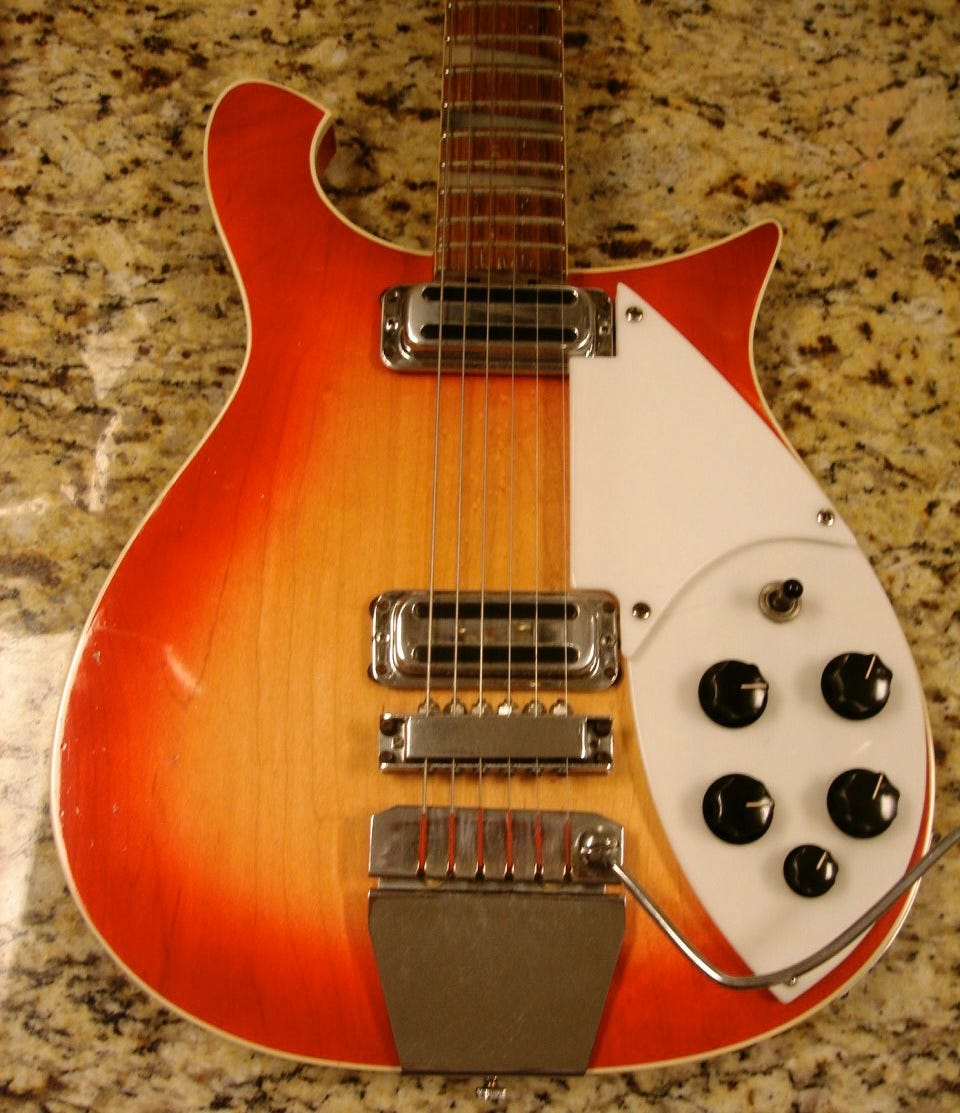
The 625 was really a 450 with deluxe appointments (click to learn more) and a different deck height (click to learn more). And you see where this is going, right?
It’s really a Combo 600.
In 1963, the New Capris morphed into the modern 330 and 360OS, like this 1963 365OS:

The modern 330 and 360OS are really just slightly smaller New Capris with white plastics, and we’ve already traced those step by step back to the Combo 850.
Which is really a Combo 600.
1964 saw the introduction of the New Style 360:

The New Style 360 is really a 360OS with rounded horns and a rounded-over top. Which…you know.
It’s really a Combo 600.
And then there’s the 1967 6000 Bantar:

I’ll give you that one. The Bantar is the anti-Combo 600.
And maybe—maybe—I’m stretching it a bit with the 1968 6006 and 6005 Banjoline twins:

But really, squint and what do you see? A slightly misshapen New Style 360 with a German carve. And what, really, is a New Style 360?
It’s a Combo 600.
But there’s no stretching it with the 1969 381:

That’s a big 360OS with a German carve. And there’s no question what a 360OS is.
It’s a Combo 600.
1970s new models were almost entirely 4000s and Forrest Whites. I’m not saying the fact that they’re not Combo 600s is the reason they’re not still around, but I’m not not saying that either.
We did get the doubleneck 362 in 1974:

The 362 is a double-wide flat-top New Style 360. There are a ton of steps in this one’s lineage: New Style 360/360OS/New Capri/Capri/long-body 325 Capri prototype/325 Capri/Combo 850.
And that makes it a Combo 600.
1983 brought us the 350:

This one’s easy. The 350 is a full-size 325 Capri, which is a Combo 850.
And that’s a Combo 600.
But we’ve now more or less covered all the branches of the family tree, right? Well, John Hall launched a couple of modern models during his time, like the 650 in 1992:

But of course, the 650 is a 24-fret 450, which is a Combo 450 which is a Combo 400 which is a…
Combo 600.
And last but not least is what is probably the most underappreciated model of the John Hall era, 1995’s 380L Laguna:

I don’t even need to say it, do I? You know what it is.
Ok, maybe I’m reaching a bit with this whole “everything is a Combo 600” shtick. But there’s a real kernel of truth in there: all of these guitars can directly trace their design lineage back to the Combo 600, a mostly forgotten model from the very start of the modern Rickenbacker story.
When I wrote my article on the Combo 600 and 800 (click to read), my basic thesis was that those guitars were basically placeholders while F.C. Hall figured out how to run a guitar company. And I stand by that.
But it turns out they’re a lot more important than I gave them credit for.
How could they not be when everything’s a Combo 600?
If it looks, walks, and quacks like duck…….😁
I burst out laughing at this, pure delight. :D Everything's an amoeba! .. just with a few variations.