

People sometimes ask how I decide what to write about next. The short answer is there are two paths.
Most of the time, an idea grabs me so completely that I just drop everything and start writing.
But then there’s “the list.” Whenever I think of a topic that deserves an article but doesn’t spark my interest right then, it goes onto the list. At the moment there are more than fifty of them patiently waiting their turn. About half are partially written, abandoned when something shinier came along. The rest are simply…waiting for inspiration.
The 420/425 has been camping near the bottom of that list for well over a year.
That’s a little unfair, really. It’s an important model with a long production run, and once this article is finished I’ll probably have to go back and add links to it from dozens of other articles across the site.
But I’ll be honest—it still isn’t speaking to me. Let’s see if writing it changes that.
Few Rickenbacker models get misidentified more often than the 420 and 425. And that’s one hundred percent down to Rickenbacker screwing up the model number from the very start.
You see, there’s a rule in Rickenbacker model numbering: models that end with a 5 have a vibrato, and models that end with an 0 don’t. Yet when the 425 was introduced in 1958, it did not have a vibrato.
Now the rule was only a year old at that point, but still: how do you forget a brand new rule? Or, worse yet, why establish it only to ignore it immediately?
The 425—despite its brand new (if wrong) model number—wasn’t actually a brand new model. You could argue it replaced the Combo 400, but that’s not quite right either. If anything, it was more of a rebrand than a replacement. Let me show you why.

This is the 1956 Combo 400 (click to learn more). It was the third electric Spanish model offered by Rickenbacker after F.C. Hall’s purchase of the company in 1953, and the first Rickenbacker designed by Roger Rossmeisl (click to learn more).
Hall’s first two offerings—the 1954 Combo 600 and 800 (click to learn more)—were almost more proofs of concept than finished products, and he took what he had learned from them to develop Rossmeisl’s design brief for the Combo 400.
That brief called for a simple, scalable solidbody entry-level guitar. Which the Combo 400 absolutely was—even if it looked a little funny with its tulip-shaped top.

In 1957 the Combo 400 family grew with the addition of the Combo 450 (click to learn more)—a Combo 400 with an extra pickup. Later in the year, the Combo 450—but not the Combo 400—underwent surgery on the lower cutaway to improve player access to the higher frets.

1958 brought the model’s most dramatic visual change: the introduction of the cresting wave (click to learn more) cutaway.

But the new design is more evolutionary than revolutionary. Look closely at the new upper horn and you’ll see that the outer profile hasn’t changed at all. Instead, Rossmeisl simply scooped away the inside edge to create the distinctive cresting wave silhouette.
Now we’ve been talking about the two-pickup Combo 450, but the one-pickup model underwent the same redesign at the same time. And with that redesign came a new name: the Combo 425.

Before we talk about the guitar itself, we need to briefly talk about its name. Not the 425 bit—we’ve already established that’s wrong—but the “Combo” bit.

Rickenbacker price lists continued to refer to solidbodied guitars as the “Combo Series” through 1969. Collectors don’t. But collectors also don’t entirely agree on where the Combo name should stop.
There are two primary schools of thought. The first says the name “Combo” belongs only to the tulip-bodied guitars. Once the cresting wave bodies arrive, the Combo name dies with them.
The second school argues that the Combo era ends with the 1961 redesign, when the 425 and 450 shrank from1 5/8-inch to 1 1/4-inch bodies and gained contoured edges.
Both arguments have merit, but simply because I think it’s cleaner I’m going with “the Combo died when the tulip did” school in this article.

So back to the guitar. There were four major changes—apart from the body shape—between the last Combo 400 and the first 425.
First, while the Combo 450 had launched with Rickenbacker’s brand new toaster pickup in place of the Combo 400’s DeArmond unit (click to learn more), the Combo 400 itself was never similarly upgraded. The 425, however, launched with a toaster from the very beginning.
And not only was the pickup new, its location was too, moving from the neck to the bridge position. The pickguard it mounted to was now white plastic instead of the anodized aluminum found on the older Combo 400—and the redesigned 450.
That made sense, given the overall design language Rickenbacker was developing. At this point in the company’s history, two features consistently signified student or entry-level models: white plastics and the so-called “aluminum foil” truss rod cover (click to learn more).

The 425 was clearly positioned as Rickenbacker’s entry-level full-sized model both by the design elements we’ve discussed and by its price. At $149.50—about $1,700 today—it cost a full $100 (about $1,150 today) less than a 330. The two-pickup 450 added another $35 (about $400 today).
For comparison, the 1958 Duo-Sonic—a model that occupied roughly the same place as the 425 in Fender’s lineup—carried the exact same $149.50 price tag. The Telecaster cost $199.50 (about $2,250 today), putting it very close to the 450.
That’s almost certainly no coincidence. As Fender’s former exclusive distributor—and a part owner—F.C. Hall knew the company’s products, pricing, and market positioning as well as anyone. He clearly knew who he believed the competition to be.
Now that we’ve established the 425’s historical context and its place in the Rickenbacker lineup, let’s run through the year-by-year changes to see how the model evolved.
1958-1960
Like the Combo 400 it replaced, the 425 launched with neck-through construction (click to learn more)—which feels a little ironic given that today neck-through construction is usually associated with high-end or boutique instruments rather than entry-level guitars. The one-piece through-neck section and body wings were all solid maple. At launch, the 425 featured maple headstock wings.

Almost immediately, the maple headstock wings gave way to walnut. The 425 retained the open-geared Grover Sta-Tite tuners (click to learn more) however—another signifier of its entry-level positioning.

While the pickup and its location may have changed from the Combo 400’s, the controls did not. The 425 featured volume and tone controls, as well as a two-way switch that either did nothing or engaged an early Telecaster-style low-pass “strangle switch” for darker tones. The output jack also remained face-mounted.

The bridge was equally familiar. The 425 utilized the same bridgeplate and standard six-saddle bridge that all solidbodied Rickenbackers had used up to that point—hidden beneath a chrome “ashtray” bridge cover that clipped onto the pickguard. The serial number was stamped into the bridgeplate.
Flipping the guitar over, we can see that the thoroughly useless saxophone ring from the Combo 400 carried over to the 425—although it also had more useful traditional strap buttons. You’ll also notice two white dots in the neck-through section.

Those dots are the relics of tooling locating pins used to hold the instrument during the manufacturing process.
Usually it’s fairly easy to narrow down—if not always pinpoint—when a spec change occurred. Not so with a quartet of changes that occurred sometime over the 425’s first three years of production.
Complicating matters is the serial numbering scheme (click to learn more) in place at the time. Unlike the scheme used from 1961 onward, which tells us the year and month (or even week) of production—or the system used on other Rickenbacker models at the time, which at least identifies the production year—the 425’s serial numbers from 1958 to 1960 provide almost no useful dating information. Pot codes are our best bet—when we have them.
So here’s what we know changed over that period, even if we don’t know exactly when. My best guess is late 1958 or early 1959.
First, working from top to bottom, the Grover Sta-Tite tuners were replaced by Kluson Deluxe units with white plastic buttons.

There’s one interesting detail that the photo above—which shows a Fireglow guitar—doesn’t make obvious. Here are the colors the 425 was offered during this period:
1958: Jet Black (Jetglo), Natural (Mapleglo), and Montezuma Brown.
1959-1960: Black Diamond (Jetglo), Natural, and Fireglow (Fireglo).
On every finish except Black, the neck and headstock were painted to match the body. Black guitars, however, retained Natural-finished necks and headstocks. So if you see a Black 425 from this era with a black neck or headstock, it’s almost certainly been refinished.
The second change was arguably the most consequential: the single pickup moved farther away from the bridge, slightly mellowing the guitar’s tone.

Change number three, also shown above, saw the controls reoriented into a diamond pattern.
For change number four, we have to flip the guitar over.

The cursed saxophone ring was at long last banished from the Rickenbacker line.
Those four changes are frustratingly hard to date. Fortunately, the changes introduced in 1961 are much easier to pin down.
1961-1962
It should become clear relatively quickly why some collectors consider 1961 as the end of the Combo era. Starting in May, many of the cruder elements of the 425’s design that had carried over from the Combo 400 began a refinement process that would carry into 1962.
And thanks to the new-for-1961 year/month serial numbering system, it’s also much easier to pinpoint exactly when those changes occurred.
The first—and most consequential—arrived in May 1961, when the 425’s body shrank from 1 5/8 inches to 1 1/4 inches, and its edges became contoured for greater player comfort.

At the same time, the shape of the pickguard smoothed out slightly, with what had been angles giving way to gentle curves—a process that would continue on into 1962. The material changed as well—transitioning to “sign white” Plexiglas on all models with white plastics.


One year later, in May 1962, a number of changes brought the 425 much closer to its definitive 1960s specifications. At the top, the wings of the headstock changed from walnut back to maple, and the “aluminum foil” truss rod cover gave way to the white backpainted Plexiglas truss rod cover that was on its way to becoming the company’s standard.

A number of changes happened at the other end as well. The pickup moved even farther from the bridge—to what was essentially the exact middle position—the pickguard’s shape softened a little further still, and the bridge underwent a significant redesign.

The 425’s bridgeplate was shortened by about half an inch, and the six-saddle bridge was replaced by a floating, one-piece compensated unit. The entire assembly was neatly framed by a new pickguard cutout that also helped hold the bridge in place.

And finally, the last link to the Combo 400—the tool-locating pin holes on the back—disappeared for good.
But we can’t talk about the 425 and 1962 without discussing one of the oddest Rickenbacker models of the early 1960s: the private label Contello/Symfonia Grand (click to learn more).

Produced for the Mann Music School, the Contello/Symfonia Grand was based on the 425, but featured a number of cosmetic changes and one significant structural departure—a two-piece body with a set-neck. The model would ultimately prove an important proof of concept for a guitar that debuted the following year.
And I’d be remiss if I didn’t mention that one of the most famous—if not the most famous—425s was a 1962 model (click to learn more) bought by a pre-fame lad from Liverpool during a 1963 trip to the United States to visit his sister.

1963-1964
The Contello/Symfonia Grand proved that music schools were a lucrative market with strong demand for private-label student instruments. Rickenbacker responded with two models (click to learn more) in 1963: the ES-16, based on the short-scale 1000 (click to learn more), and the 425-based ES-17.

If the ES-17 looks like a stock 425 with a funny truss rod cover, that’s because it is a stock 425 with a funny truss rod cover. Buyers could order the guitar with their own name on the headstock or with “Electro” branding—once Rickenbacker’s primary brand, now relegated to private-label duty.

In classic waste-not-want-not Rickenbacker fashion, early ES-17 truss rod covers simply riveted an Electro lap steel badge onto a blank Rickenbacker cover. But by early 1964 Electro guitars had their own unique back-painted Plexiglas cover.

Changes to the 425 were minimal over the course of 1963 and 1964—and most were line-wide rather than model specific.
In December 1963, the headstock on all models narrowed slightly to what is commonly referred to as the “vintage” shape. The following month, in January 1964, all Rickenbacker truss rod covers had “MADE IN U.S.A.” added below and parallel to the logo at Rose-Morris’s request for the UK market.

At the same time, the neck heel on the back transitioned from square to rounded—a line-wide change that accompanied the move to the smaller “vintage” headstock.


Those small details—a slightly narrower headstock, a rounded heel—were the 425’s final substantive design changes. Well, almost.
1965-1967
In 1965 Rickenbacker finally corrected the mistake they had made back at the 425’s launch—in the worst possible way.
The 425 was officially renamed the 420. Had they left it at that, it would have been confusing enough for future collectors. But Rickenbacker couldn’t resist making things even more confusing by introducing an entirely new 425—this time with a vibrato, just as the model number had always suggested.

The new 425’s vibrato—often misidentified as a “Boyd” vibrato (click to learn more)—was a simple, off-the-shelf Japanese unit.

Hidden beneath the chrome cover was a bar that served as both the string anchor and the pivot point. Pushing or pulling on the arm rotated the bar, lowering or raising the pitch. Springs returned it to its neutral position.
While simple, its performance was no worse than the Accent vibrato (click to learn more) fitted to higher-end models—and may, in fact, have been slightly better!
A number of minor changes were made to the 425 to accommodate the new vibrato. The bridgeplate became unnecessary and was eliminated. The pickguard was reshaped to make room for the vibrato unit while also helping hold the floating bridge in place. And, for reasons that aren’t immediately apparent, the control layout was slightly altered.

The loss of the bridgeplate caused a problem that probably hasn’t occurred to you: where do you stamp the serial number?

We have an entire article explaining how the system worked here (click to learn more), but the short version is this: the production number was stamped onto the base of the vibrato cover, but not the year/month code. To narrow down a guitar’s age you have to use pot codes to estimate the year and data from the Rickenbacker Register to estimate the month. It’s less than ideal, but it is what it is.
The “new” 1965 420 was identical to the “old” 1964 425 in every way except the model number. But a significant change would begin phasing in around October 1965, and it’s going to look weird to you.
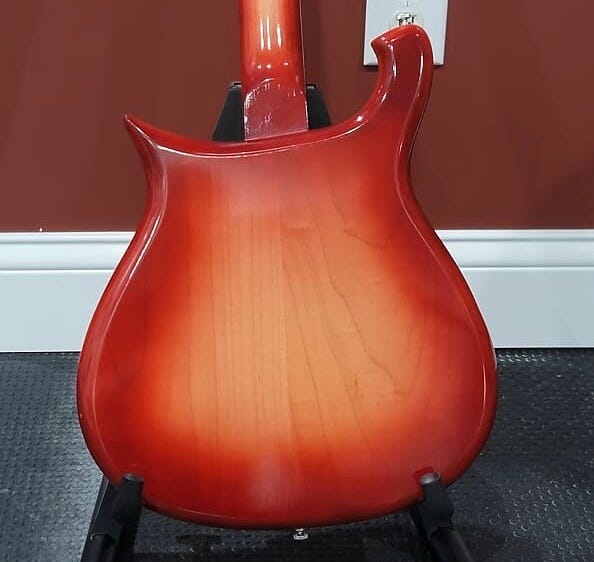
So yes, the big change is that the 420 and 425 transitioned from neck-through construction to a set neck with a two-piece maple body—probably in an effort to reduce manufacturing costs on this entry-level model. But that’s likely not what first caught your eye in the photo above.
The contour on the back now extended around the entire perimeter of the body, not just the lower bout as it had only a few months earlier. And that just doesn’t look right.

Apparently Rickenbacker thought so too. Well, probably not that—they likely realized they could save a little labor by going back to the old contours. Either way, by early 1967 the backs of the cutaways were no longer contoured.
Funnily, I have yet to come across a 425 with this contoured back—even among those built between late 1965 and early 1967 when most 420s had it.
It’s also worth mentioning that you will in fact find neck-through 420s and 425s during this era. The 450 was still neck-through, and sometimes they grabbed whatever body happened to be working its way through the shop. So don’t be surprised to flip a guitar over and find a through neck.
The last changes of note during the 1965-1967 period also appeared around October 1965. The bridgeplate reverted to the longer version that had been used prior to 1962, and the cutout in the pickguard was altered to fit. At the same time, the controls on the 420 shifted to match the layout that had first appeared on the new 425.

Although it would remain on the price list through 1974, the 425’s story appears to have ended in 1967 as I have found no documented examples built after then. But its legacy lives on to this day, continuing to confuse collectors trying to distinguish between the original 425, the renamed 420, and the new “with vibrato” 425.
1968-1984
The remainder of the 420’s life was, all things considered, relatively uneventful. Most changes were either part of line-wide changes, like truss rod cover tweaks (click to learn more), or simply brought the model in line with the rest of the product range. In several ways, the 420 had lagged behind the rest of the lineup.
For example, by 1968 the 420 and its private-label ES-17 variant—which remained in production through 1972—were the last Rickenbacker models still using Kluson Deluxe tuners with white plastic buttons. They may have been marginally cheaper, but they were also one more unique part the factory had to keep in inventory. In 1969 they gave way to the nickel button Klusons used on every other guitar.

And then there were the knobs. Along with the 4000 bass, the 420 was one of the last two-knob instruments in the Rickenbacker line. Starting in 1965, all four and five knob guitars had transitioned to the silver-topped knobs with their familiar “Treble Tone” and “Bass Volume” labels.
The 420, however, had carried on with the old black Kurz-Kach knobs—the silver-topped knobs bore labels that simply didn’t apply to a one-pickup guitar. In 1975 they were finally replaced with unlabeled silver-top knobs.

And finally there’s the pickup. The 420 and 450 were the last holdouts outfitted with toaster pickups after the rise of the Higain in the early 1970s. That ended in 1974 when the single toaster pickup was replaced with a button-top Higain.
But because Rickenbacker is gonna Rickenbacker, in 1975 the white plastic-button Klusons returned.

The 420 saw no further model-specific changes after 1975.
As Rickenbacker guitar sales slowly increased in the early 1980s and the backlog once again began to grow, an entry-level model whose sales had never been stellar became more of a distraction than an asset. After John Hall bought the company from his father in 1984 he ruthlessly pruned the product line. The 420 did not appear on the 1985 price list.
1999 Postscript
In 1999 John Hall announced two new special run guitars: the 425V63 and 450V63 (click to learn more). A limited ordering window was opened, and only as many guitars as were ordered during that period would be built.

Inspired by George Harrison’s 1962 425, both models were fairly faithful reproductions of the 1962 guitars—the only obvious anachronism was the longer bridgeplate. The guitars were offered in Jetglo and Burgundyglo—a finish that didn’t exist in 1962.
The guitars also marked the debut of the new scatterwound toaster pickups, the most faithful reproductions yet of the original vintage units. 84 425V63s were produced in Jetglo and 34 in Burgundyglo.
And that’s everything you could ever want to know about the 425/420—the little entry-level guitar that could.
I’ll admit it took me a while to get into this one, but here’s the thing I love about this process: researching this article connected a pair of dots that had always been right in front of me, yet I had never seen before. I had always thought of the 1963 reduction in headstock width and transition from square to rounded heels as two separate events. They’re not. They are directly related—you don’t get one without the other.
So now I have a whole bunch of Timeline articles to go update…along with adding a ton of links back to this one.
Rickenbacker 101 is such a fantastic endeavor. Another great column. I had a 425 for decades. Love this segment.
Curious if you'd like to shed some light on the limited "425's" released in 2025, such as this: https://justrickenbackers.com/inventory/individual/?id=117