

I’m an unapologetic 330 lover. If you ask me “what should my first Rickenbacker be?” my answer is always going to be “a 330”. It’s got the look, it’s got the sound, there’s always plenty of them available, and it won’t break the bank. But as much as I love the 330, it’s not the flagship Rickenbacker model. That would be the 360.
The 360 has the triangle inlays, the fancy binding, and of course it has the Rick-O-Sound (click to learn more) stereo wiring. If you want the full Rickenbacker experience, you’re gonna want the Rick-O-Sound—even though you’ll probably never use it. And if you want all that, well, you’re gonna need a 360. So let’s talk about them.
The 360’s story—along with the 330’s—begins in 1958 with the introduction of the brand new semi-hollowbody Capri line. And to tell the story of how we got from there to here we’ll actually be discussing four models that were all built on the same foundation: the two-pickup 360, the “360 with a vibrato” 365, the “360 with a third pickup” 370, and the “360 with a third pickup and a vibrato” 375. Apart from the number of pickups and the presence or absence of a vibrato, all four of these models are the same underneath.
And as we discuss changes, bear in mind that prior to the introduction of CNC manufacturing in 1995 these were largely handmade instruments, with tooling that wore down over time and was replaced with tooling that didn’t necessarily replicate exactly what it was replacing. The point being that body, neck, and headstock shapes all continuously vary slightly over time. We’re not going to try and capture that here—it would just be impossible. We’re going to focus instead on significant or easily identifiable changes. Make sense?
If you’ve already read our 330 timeline (click to read) you’re going to recognize a lot of this because let’s face it: from its launch in 1958 until 1964 the 360 was just a fancied up 330. And even after the round top “New Style” 360 launched in 1964 and the two body shapes diverged, the two models still used a lot of the same basic hardware and electronics. So apologies if a lot of this seems familiar. But I promise there are more than enough differences to make the read worth your while! And so with that in mind, let’s begin.
1958
The full size semi-hollowbody Capri models introduced in 1958—Capri being the name of F.C. Hall’s family cat—were the product of an evolution that traces all the way back to Rickenbacker’s first “modern” electric guitars, the 1954 Combo 600 and 800 (click to learn more).

Originally designed by industrial designer Hunt Lewis, the newly hired Roger Rossmeisl (click to learn more) added his own flourishes to the original drawings by slightly reshaping the treble cutaway and adding a German carve (click to learn more) to the top. Then, in 1957, Rossmeisl significantly modified the bass cutaway to create the Combo 850.

Still tinkering, Rossmeisl then took this basic shape—which was a solidbody—and hollowed it out by carving it out from the back and then added a short scale neck to create the first true semi-hollowbody Rickenbacker, the “Polynesian” (click to learn more) prototype, so called in honor of the local band F.C. Hall loaned the guitar to for feedback.
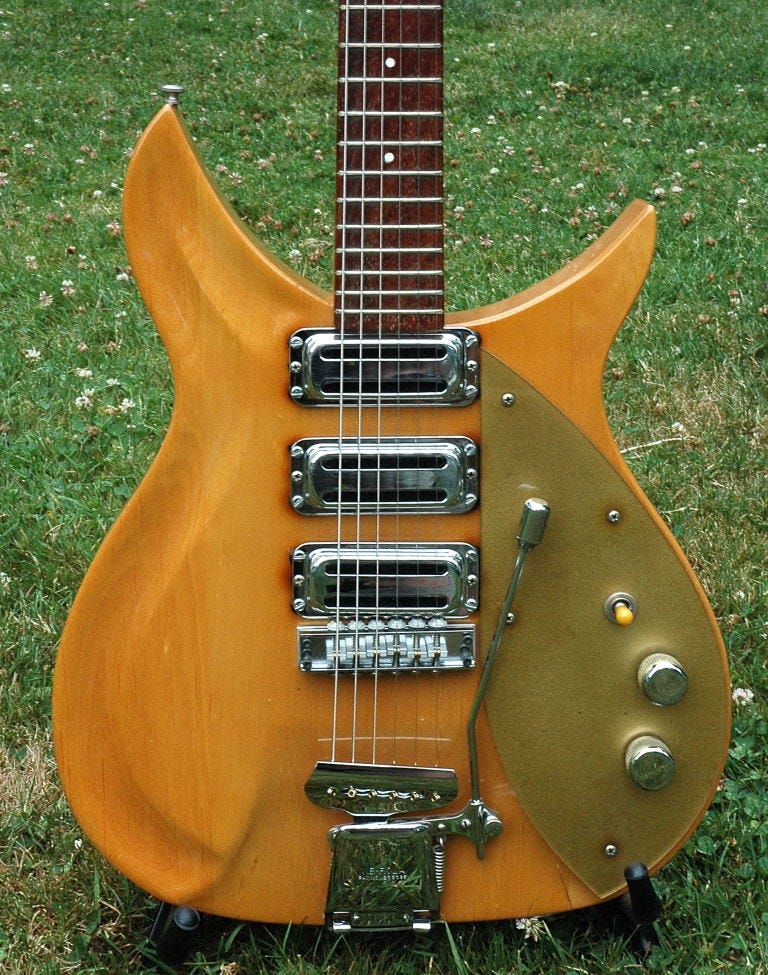
Realizing the German carve would be difficult/expensive for large-scale production—remember, these were still largely hand-carved by Rossmeisl (and his assistant Semie Moseley, who would later add this design element to his own Mosrite guitars)—the top was flattened, and so was born the semi-hollowbody short scale Capri.

But we’re not done yet! Rossmeisl then built a handful of short scale Capris with a longer body—but still the short scale neck:

He then added a regular scale neck to this body:

The long body was then widened, and a “cat’s eye/slash” soundhole was added (one of the first long-body prototypes actually had a painted-on cat’s eye soundhole!). Et voila—the full size Capri had arrived.

The full-sized Capri line of semi-hollowbodied guitars debuted with a total of eight models split evenly between “deluxe” (click to learn more) 360 models and “standard” 330 models. The differences between the two were purely cosmetic—the 360 featured a double bound body with a bound neck and triangle inlays while the 330 had no binding and simple dot markers. But the underlying foundation was identical: a 2” thick double cutaway back-carved semi-hollow body with a slash soundhole, two or three toaster pickups, and a set 21-fret neck.
Several body materials/constructions were used before they standardized on a three-piece maple body. These early guitars can be found with bodies made of alder, birch, “butcher block” maple, mahogany, and two piece maple. Back construction began as birch plywood before standardizing on solid three-piece maple.


The necks began as solid maple with maple headstock wings—as the short scale Capris would remain—before landing on the now familiar three piece sandwich. However, these early necks featured shedua instead of today’s walnut for the center stripe and headstock wings, consistent with Rossmeisl’s pre-Rickenbacker and prototype multi-piece neck designs.


Both Kluson Deluxe and Grover Sta-Tite (click to learn more) tuners could be found on early Capris, although they would eventually standardize on the Klusons in 1959. The headstock also featured a gold back-painted truss rod cover.
While dual hairpin truss rods (click to learn more) would later become a Rickenbacker hallmark, the Capri models would all be equipped with a single hairpin rod.

If you look closely, the triangle inlays (click to learn more) on the early 1958 360s may look “extra pointy”. That’s because they are. Let’s compare an early 1958 365…

With a late 1958 375:

The Capri’s inlays were a polyester resin—the triangles were routed out, the sides of the fingerboard were dammed and the liquid resin was poured in and allowed to dry in place. On early 1958 Capris, the triangle was routed to a very sharp point, but by the end of the year the point was softened and eventually lost altogether.
Fingerboards were paduak—despite being very similar in appearance, Rickenbacker’s “trademark” bubinga would not make an appearance for several years. These early boards also did not feature Rickenbacker’s now characteristic finished fretboards.
The soon-to-be “signature” Rickenbacker cat’s eye/slash soundhole went through at least three iterations over the course of the year. Prototype and very early production models featured an extra-long soundhole of about 8 3/4” with a curved tail:

Version two would be shorter at 8 5/16” and without the curved tail:

The final version—still in use today—came in at 6 1/8”:

Very early non-vibrato guitars came equipped with a generic, off-the-shelf tailpiece. This would quickly be replaced with the now familiar trapeze tailpiece.


Vibrato-equipped 365s and 375s came with the extremely outdated Kauffman Vibrola (click to learn more)—which had first appeared in the 1930s.

Vibrato models came with roller saddles on a six-saddle adjustable bridge. Non-vibrato models featured the standard Rickenbacker six-saddle adjustable bridges found on all other Rickenbacker models.
You’ll have noticed that many of the Capris we’ve looked at up this point feature a single-level gold back-painted teardrop pickguard and a two control knob layout with one or two switches—often with seemingly different control locations on each example.

If you want to go down an inconclusive rabbit hole, try looking up what those early harnesses actually do! Suffice it to say that by the end of the year the guitar had received an upper guard for player comfort, and a more familiar four knob/one switch layout. We should also note that the earliest guitars had chrome metal lap steel knobs, but those transitioned fairly quickly to the brown Rogan “cooker” knobs.

The guitar above more or less represents the “final” configuration of the 1958 Capri, with its three piece maple top, short slash F-hole, three piece neck, larger inlays, and two-level pickguard with four Rogan knobs/one switch controls.
1959
At the beginning of 1959, tuners standardized to Kluson “single line” Deluxes with small hex bushings.

A subtle change occurred towards the middle of 1959. Up to this point, the edge of the pickguard on all guitars was flush with the pickups—as it remains on three pickup guitars today. Midway through the year, however, this changed on two pickup models: the upper pickguard was extended approximately half an inch between the pickups. This pickguard layout remains standard to this day.


A much more significant change occurred towards the end of the year: Rickenbacker transitioned from a nitrocellulose finish to a conversion varnish (click to learn more). With this change, fretboards gained their now-customary glossy finish.

Also towards the end of the year, the finicky Kauffman Vibrola on the 365 and 375 was replaced with the Accent vibrato (click to learn more), a design licensed from Paul D. Butts. The same design would be licensed a year or two later by Gibson and branded as the “Maestro Vibrola”. At launch the Accent wore a small rhomboid “Ac’cent by paul” plaque on the front.

That said, the Kauffman did not immediately disappear. It would continue to be used on some guitars into early 1960. Not only that, but the “long” Kauffman previously used on F-body guitars would begin appearing on Capri models during this period as well—possibly to use up leftover stock.


1959 also saw the introduction of Fireglow (with a “w”, at this point), the quintessential Rickenbacker finish.
1960
The 360 saw only one significant change in 1960, but it was a significant one indeed: the introduction of “Rick-O-Sound” stereo wiring.

Introduced in the middle of the year, it became standard on all 360 variants. The “lower” output jack was a standard mono jack while the “upper” output jack was stereo. An optional “Rick-O-Sound” box—a glorified stereo-to-mono splitter—plugged into this jack and provided two separate outputs, one for each pickup.

1961
Always a tinkerer, Roger Rossmeisl had one last major trick up his sleeve before his tenure at Rickenbacker came to an end. Midway through 1961 Rossmeisl took the existing Capri body and enlarged the horns, lowered and pinched the waist slightly, and reduced the body depth from 2” to 1 1/2” to create the “New Capri” 300 series guitars. And thus, with only minor changes since, the modern shape of the flat-top 360 and 330 was born.

All hardware and plastics from the “old” Capri carried over—gold back-painted pickguard and truss rod cover, trapeze or Accent by Paul tailpiece, brown Rogan knobs—with one notable addition: the mysterious fifth “blend knob” (click to learn more).
I can’t begin to tell you how many times I have tried and failed to come up with a clear, one sentence explanation of what that knob does. The best I’ve come up with is this: because the output between the neck and bridge pickup on guitars that featured the “vintage tone circuit” (click to learn more) was so different, the knob controls the volume of the neck pickup relative to the bridge pickup to allow a more precise fine-tuning of the blend.
The 1961 New Capris also gained a sparkly addition: the poured resin triangle inlays were replaced by crushed pearl triangle inlays.

This would be a one-year-only feature, as the poured resin inlays would reappear in 1962. And while crushed pearl would reappear in 1964, it’s generally believed that the 1961 inlays were made from a different material as the flakes appear larger on the 1961 guitars.
The New Capri would also see the 360 transition from a single hairpin truss rod to dual hairpins—a defining feature for Rickenbacker guitars and basses throughout their peak era and beyond.

Now a question that often gets asked is “at what point did the ‘New Capri’ stop being a ‘New Capri’”? That’s a great question. In fact, company literature never actually referred to them as “New Capris”—and indeed the Capri moniker was already gone on the 1960 price list—the “Capri” models were merely referred to as “310–375 Series, Thin Body.” Meaning that “New Capri” itself may well just be a collector’s term that’s been used so long we all just assume it’s legit.
The commonly accepted answer to the question—but by no means a definitive one—is “when the gold plastics go away.” That’s as good an answer as any—and about as authoritative.
1963
So by the “end of the New Capri?” definition we just established, late 1963 was the end of the New Capri. And this particular guitar sealed its fate:
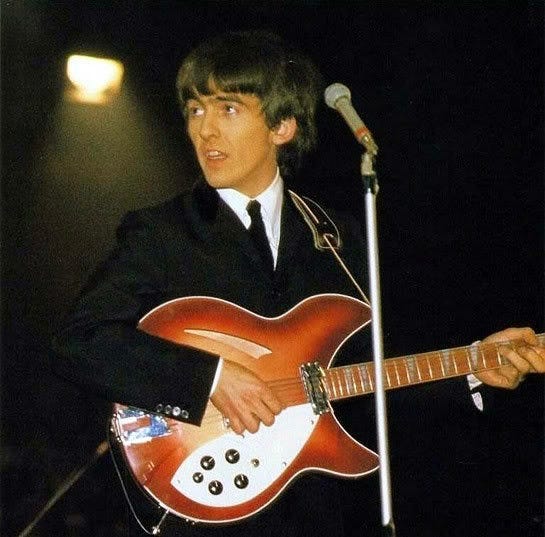
That guitar marked the end of the gold plastics era. White plastics had begun appearing on other guitars in 1961, but by the end of 1963 the “New Capris” were the last gold holdouts. But from this point on all the 330 and 360 models would wear white plastics.
Along with the white plastics, black KK (Kurz Kasch) knobs would replace the brown Rogan cooker knobs.
Midway through the year, Van Ghent tuners (click to learn more) with pearloid buttons began appearing on most (but not all) deluxe models, including the 360. Despite their fancy buttons, the teardrop covers on the back concealed simple open gearing. They appear to have been chosen for their appearance rather than any meaningful improvement in performance.


Also in late 1963 the Accent Vibrato would lose the small “Ac’cent by paul” plaque.

But before all that happened, there was one very important 360 New Capri: the Suzi Arden 360/12 (click to learn more).

This was the very first Rickenbacker 12-string guitar, built in July of 1963. Shop manager Richard Burke designed the ingenious headstock—with its sideways tuners—to meet F.C. Hall’s request to keep it as short as possible.

The guitar was strung “normally” for a 12-string with the octave strings coming first, as opposed to what would later become Rickenbacker’s trademark “reverse” stringing. The standard adjustable six-saddle bridge would have two notches cut in each saddle to accommodate the extra strings. Apart from the accommodations for the extra strings, the rest of the guitar was a standard 360 New Capri (the “R” tailpiece in the picture above was a later modification; new it featured a trapeze tailpiece).
The second Rickenbacker 12-string, built in November, made the switch to white plastics and Rickenbacker reverse stringing. You already know where that one wound up. If not…scroll back up to the beginning of the year!
1964
As important as 1958 is to the 360 story, 1964 is the year the 360 as we know it today was truly born—in a case of spectacularly bad timing!
The first production batch of the new round-top 360 was built in August, 1964. You know what else happened that month? A Hard Day’s Night hit the theaters, with George Harrison playing the flat-top 1963 360/12OS he’d received earlier in the year—a guitar that had quite literally just been replaced and could no longer be purchased. And yet, somehow, the “New Style” 360 survived and thrived.

A quick terminology note: to distinguish between the older flat-top top and newer round top designs, you will usually see the older design referred to as OS or “Old Style”—even when discussing guitars produced before the round-top version appeared. While you will sometimes see the round-tops referred to as NS or “New Style”, the term is largely redundant and seldom used except when distinction between the two versions is required. We’ll be using it frequently here in that context.
Rossmeisl had left Rickenbacker for Fender in 1962, which made the new round-top 360 the first significant evolution of the design after his departure. So who was responsible?
As with almost all post-Rossmeisl 1960s design changes, the answer is shop manager Dick Burke—though some employees derided it at first for looking like a “toilet seat”! Burke was also responsible for the ingenious slotted headstock design (click to learn more) on the twelve-string variant.
The standard solid-body guitars had had their edges rounded over in the name of player comfort in 1961. Burke took that idea to its logical extreme—softening the horns and rounding over the entire top of the guitar. The result was a dramatically different feel—both visually and physically—despite the guitar remaining fundamentally the same underneath.

The biggest difference between Burke’s initial design and the finished product was the treble cutaway horn—slightly smaller than what production models would ultimately receive. There would also be a handful of similar prototypes influenced by the Rose Morris guitars dominating current production.

The back of the guitar got the fancy checkered binding that had first appeared on the deluxe F-bodied guitars in 1958. Well…eventually. Prototypes and the first production batch from August featured plain white binding, but subsequent guitars made the switch to the checkered binding we associate with vintage (click to learn more) 360s.


To make up for having lost its bound top, the New Style 360 got a new deluxe feature: Rickenbacker’s first production bound soundhole.

The New Style 360 also saw the return of crushed pearl triangle inlays. This feature would carry over to all deluxe models by the end of the year.

Two other new features—both of which would soon spread across the entire line—also debuted on the New Style 360. The first of these was the knobs.

The black KK knobs that had first appeared on the 360 just a year earlier were replaced with silver-topped knobs featuring an indicator dash on the top, and a dot on the skirt. These first knobs would not feature the now familiar Treble/Bass Tone/Volume labels.
The other new feature appeared with the 360/12—the second production Rickenbacker 12-string guitar behind the Rose Morris 1993—when it entered production in September: the now iconic “R” tailpiece.


This first iteration of the tailpiece was heavy, made of chrome-plated cast brass with the string slots on the back hand-cut with a hacksaw. They all had twelve slots cut—even when used on six-string guitars—so the factory could use the same part on any configuration.

Fun fact: all guitars from the first production batch of the six-string New Style 360 were equipped with the Accent vibrato, as the new tailpiece was not quite ready.
So while the 360 was completely new for 1964, there were a number of company-wide changes that year that impacted the model as well. One of these stemmed from a request Rose Morris had made: they asked for “MADE IN U.S.A.” to be added to the truss rod cover on guitars destined for the UK. Rather than carry two separate parts, Rickenbacker applied this change across the entire product line.

You’ll notice that this August 1964 example features the Van Ghent tuners that first appeared in 1963—and indeed most 1964 six-string production examples do. The twelve-string, however, used the Kluson Deluxes found on all other models, although those tuners themselves changed in 1964 from the “single line” logo on the back to the “double line”. The double line tuners also had round bushings as opposed to the hex bushings used on the single line versions.


Six-string guitar headstocks also slimmed down noticeably in 1964 across the line, losing well over a quarter-inch of width—most noticeable in the width of the walnut wings.


Finally, midway through the year the toaster pickup bobbins lost the injection molding “dimple marks” in the corners, becoming smooth all the way across the toaster slots.


It was also “around this time” that the fretboard material changed from paduak to bubinga. Not only was the transition of the Old Style 360 to the New Style now complete, but so too was the shift to what we now think of “vintage specifications”, a process that had begun with the 1961 New Capri redesign.
That this all happened in the shadow of A Hard Day’s Night—with the “wrong” guitar on screen and the “right” one just out of reach—only adds to the irony. The 360 that survived 1964 wasn’t the one audiences first fell in love with—but it was the one that would go on to define the brand for decades to come.
1965
Although sales of the New Style 360 were strong, demand from players who wanted a 360 that “looked like George Harrison’s” was high enough that Rickenbacker made the flat-top version available by custom order. Thus was born the “Old Style” or OS 360s—a flat-top version produced alongside the round-top rather than replacing it.

Apart from the double-bound flat-top shape, the OS models shared essentially all other parts and specifications with contemporary New Style 360s. Because of their relative rarity—and their close visual association with Harrison’s original guitar—mid 1960s 360/12OSs are widely regarded as among the most desirable and collectible Rickenbackers today.
Let’s return briefly to the Old Style/OS term itself—which we cover in depth here (click to learn more).

OS was an internal factory term, used in production records to differentiate between flat-top and round-top 360s, but was never an official model designation. Collectors later adopted the term to describe all 1960s flat-top 360 “New Capris”—including examples produced before the round-top New Style ever existed.
At some point—generally placed in the early 1970s transitional era (click to learn more)—that internal designation shifted to WB (with binding) or WBBS (with binding both sides). Collectors mirrored this change in their own shorthand, and today guitars from this earlier period with 21 frets are typically referred to as OS, while later 24-fret examples are grouped under the WB designation.
With that terminology clarified, the actual modifications to the 360 in 1965 were quite minor compared to the dramatic changes of 1964. While Van Ghent tuners would continue to appear sporadically into early 1966, by mid-1965 they had been replaced as the standard fitment on six-string 360s by double-line Kluson Deluxes.

Around July, the silver-top knobs—still featuring an indicator dash on the top and dot on the skirt—gained their now familiar “Treble/Bass” and “Volume/Tone” labeling.
There are two oddities worth noting from 1965. First, a small number of 365s were built with serial number stickers (click to learn more) applied beneath the clearcoat on the back of the headstock rather than using a stamped jack plate. The reason for this approach—and the exact production window in which it was used—remains unclear.

Secondly, on a handful of guitars built in January the checkered binding layer on the back was replaced with plain black binding. The general consensus among the experts is that the factory simply ran out of checkered binding and used whatever was handy until supplies could be replenished.

1966
In late 1966 the chrome-plated brass “R” tailpiece would be replaced by a chrome-plated zinc alloy version. The new tailpiece was slightly smaller, with the mounting screws spaced slightly closer, and it featured cast string-retainer slots instead of the brass version’s hand-cut slots. For the first time, separate six and twelve-string versions of the tailpiece were introduced.

Around September the final version of the silver-top knobs began appearing across the entire line, with indicator dots replacing the earlier dashes on the top. Guitars with dash-top or mismatched knobs continued to appear sporadically into 1967.

Around November/December the 360’s top changed from three pieces to two center-seamed pieces.

In December production began on a brand new model: the 6/12-string “convertible” 366/12 (click to learn more). The 336/12 and 456/12 would follow in early 1967.

When engaged, the comb you see below captures and pulls down the octave strings, muting them and “converting” the 12-string guitar to 6 strings.

On the semi-hollowbody 330 and 360 with their top-mounted pickups, the converter assembly had to be raised from the guitar face to reach the strings. A white plastic block—made of the same material as, and integrated into, the pickguard—was installed to meet this need. An extra internal bracing block was also added below this mechanism to reinforce the top.

A number of “Old Style” 366/12s were also produced over the model’s lifespan.

Although much can be said about the converter guitars, the concept ultimately had limited utility that did not last long in the marketplace. Production would end in 1968.
Here’s a fun fact: arguably the most famous 1960s round-top 360 is the 1966 370/12 played by The Byrds’ Roger McGuinn. Except it isn’t. McGuinn owned two Mapleglo 12-strings—a 1964 that was stolen and its 1966 replacement—and both were actually 360/12s with an added third pickup. On the first, the modification was done by McGuinn himself; the second was ordered that way from the factory. At the time no official 370/12 model was offered, and were it not for McGuinn there likely never would have been.

1967
Up until 1967, none of the guitars built for UK distributor Rose Morris were based on the New Style 360. That would change this year with the introduction of the model 3262 (factory designation 360S).

They never made it to Rose Morris, though. Originally intended to be based on the new 366/12 converter guitar—but with the Rose-Morris f-hole—relations with Rose Morris had deteriorated to the point where all outstanding orders were cancelled shortly after production began. The handful that had been begun received a…unique modification.

The 12-string headstock routs were covered and filled with a black plastic piece, and the guitars were finished as 6-string models. These guitars ultimately ended up being shipped to Italian distributor Saporetti & Cappelli.
1968
Around April, the MADE IN U.S.A. imprint on the back-painted plexi truss rod cover began shifting from parallel to perpendicular to the Rickenbacker logo by the nut. Higher volume models—including the 360, 360/12, the 365, and the 366/12 (but not the 370 or 375) would also have their model number printed above the MADE IN U.S.A. marking.

At around the same time the nut would change from a black phenolic material to white.
The 336/12’s production would end in September, bringing the 6/12 converter experiment to a close.

1969
Two product line-wide changes impacted the 360 in 1969. While Accent-vibrato-equipped 330 and 360s far outnumbered their non-vibrato counterparts at launch, the ratio shifted steadily until 1967 when vibrato-equipped guitars became the minority.
This trend accelerated in 1968, and in 1969 regular production of all Accent equipped guitars—including the 365 and 375—came to an end. Whether this marked the expiration of the Accent vibrato’s license or simply reflected declining demand for an aging design is unclear. While the 375 would remain on the price list through 1973 and the 365 would last through 1977(!), the “-5” model vibrato era had effectively come to an end.

Secondly, the “model number” truss rod covers introduced in 1968 proved to be quite short-lived, disappearing from all 360s by early 1969.

1970
The next few years would prove to be a particularly turbulent period for both Rickenbacker in general and the 360 in particular. We’ll therefore need to differentiate between 6-string, 12-string, and Old Style instruments separately, as each followed its own timeline.
So why all the changes? Well, Rickenbacker guitar demand had begun dropping in 1967, and by 1969 it had fallen off a cliff. From a mid-1960s peak of over 100 employees the factory workforce had shrunk to just eight by 1970. Were it not for 4001 demand taking off in 1972–73, Rickenbacker’s survival as a company would have been very much in doubt.
Facing this collapse in demand, Rickenbacker embarked on a multi-year effort to modernize its flagship 360 in hopes of regaining market share. For the six-string model, that effort began in earnest in April of 1970.
Before diving into the details, a quick caveat: many 360s from this era exhibit “mismatched” features. The dates discussed here reflect the first appearances and best estimates as to when those features became standard—but that doesn’t mean they were exclusive. Exceptions absolutely exist.

The first and most obvious change was the neck, which sprouted three additional frets, increasing the count from 21 to 24. As a result, the neck pickup moved closer to the bridge, and the pickguard was reshaped and slightly reduced in size to both accommodate the new pickup spacing while maintaining its relative position. This subtly increased the curvature on the upper guard.


The only one of the new frets to gain a marker was the twenty-fourth—but it can hardly be called a triangle.

Another change introduced along with the new neck falls into the category of details that are easy to miss—until you see them, and then you can’t unsee them. Look closely at the rounding/beveling of the treble-side horn on the 21-fret 1969 360 below:

Now compare that to a 24-fret 1970 360:

The later guitar’s round-over is noticeably smaller and more abrupt. Because the longer neck and tenon required internal changes to the body, entirely new body tooling was introduced—and it differed from the earlier pattern. This detail would persist for quite some time.
April also brought a major electronics change: the toaster pickups were replaced with first-gen Higains (click to learn more), designed to deliver a heavier sound more in line with contemporary tastes.

First-gen Higains had debuted on the 381 (click to learn more) in 1969 and began replacing the toaster pickup across the line in 1970. Unlike the toaster’s magnetic polepieces, the Higain used non-magnetic polepieces made of threaded stock that rested on a bar magnet at the bottom of the pickup. The bobbins themselves were made of clear or green PCB material and painted black.
All of those changes arrived in April. The next followed in June when the 360 received a bound headstock for a touch of visual flair.

If the 24-fret neck and Higain pickups were an attempt to appeal to the demands of the modern player, the bound headstock was simply a style upgrade.
The final new feature appeared in December, and it was a doozy: slanted frets (click to learn more).

Listed on the 1971 price list as a $100 option on “most Spanish guitars”, the feature was in practice exclusive to the 360.
Differences between the 360SF (for “Slanted Frets”) and the standard model were minimal. The neck was obviously different, but while the pickups and bridge were slanted to match the frets’ angle, they were otherwise stock units. A reshaped truss rod was produced to fit the angled nut.

Unlike the standard model, the slanted fret variant did not have a position marker at the twenty-fourth fret. And the nut received a “PAT PEND” imprint as a patent was indeed filed to cover the design.

By contrast, the 12-string and Old Style 360s saw no significant changes in 1970—but this year appears to mark the end of OS production. While it is possible a small number were built in 1971-72, the next known double bound 360s—produced in 1974—feature modern specifications and are designated WB rather than OS.

1971
In 1971 the model number returned to the truss rod cover on higher volume models—including the 360. This feature made it to the 360 in May, but would not appear on the 360/12, 370, or 370/12.

In September two related changes followed—one driven directly by the other. The aging Kluson Deluxe tuners were replaced by Grover Rotomatics (click here to learn more). Unfortunately, the Grovers’ larger footprint would not fit the existing headstock shape. The solution was the introduction of the wider Gumby headstock (click here to learn more).

The other end of the neck changed as well. The twenty-fourth fret marker was eliminated, and for the first time in the model’s history the end of the fretboard itself was bound—although not on the slanted fret version.

Once again, the 12-string 360 remained unchanged, retaining its 21-fret necks and toaster pickups, just as before. That said, there was at least one 360/12 built in 1971 with 24 slanted frets, Higains, and a bound headstock.

This may be the only 360/12SF built.
1972
1972 was a very low production year for the 360. While we see the last known appearance of some features during the year—most notably bound headstocks and slanted frets—no major changes to the model’s specifications were introduced.
Although the final 360SFs were built in 1972, the slanted fret option would remain on the price list until 1984.
On the oddities front, in September a small number of 360/12s were built with Rose Morris f-holes—likely using leftover bodies from the cancelled 1967 3262 order.

And maintaining the pattern of the last few years, the 360/12 saw no significant specification changes.
1973
1973 marked the culmination of the 360’s transition from vintage to modern specifications—a process that had begun in 1970 and now included the 12-string, which had remained largely unchanged up to this point.
The first 360 production batch of the year occurred in May and introduced a number of cost- and production-driven changes right off the bat. First among them, the 6-string guitars lost their decorative yet labor-intensive headstock binding.

At the same time the construction of the three-piece neck was revised. As a cost-saving measure, the walnut center stripe was reduced in width from 5/8” to 5/16”, and the material was changed to less expensive shedua—the same wood used as the center stripe on the 4001.


Also in that first production batch, the Higain pickups were updated. The magnet type was changed, the coils were wound slightly hotter, and the threaded stock polepieces were replaced by button-top drive screws which were painted black along with the bobbin. The button-top Higain had arrived.

The 360/12’s first change also came in May, though it was more modest. Like its 6-string counterpart, it would be fitted with the new button-top Higains, bringing the toaster era for the 360 family to an end.

The shell base material used for Rickenbacker’s crushed pearl inlays was sourced from an island near Okinawa. Around 1972-73, the waters surrounding the island were converted to a protected marine reserve, cutting off Rickenbacker’s supply and forcing the company to find a new inlay solution.
Around August the 6-string guitar transitioned to a poured pearlescent resin, a less costly approach similar in concept to the method used before crushed pearl was adopted. Rather than routing the triangles all the way across the fretboard, however, the new inlays were inset. This approach both improved fingerboard structural integrity and simplified production by eliminating the need to manually dam the fingerboard edges before pouring the liquid resin.

You’ll also notice in the photo above that at roughly the same time the 360 again lost the printed model number on its headstock, and the nut reverted to a black phenolic material.
In October both the six- and twelve-string guitars lost the two-ply checkered back binding, which was replaced by single-ply white binding.

At this point, the 6-string 360 had completed its transition, with all vintage specifications replaced by modern ones—simpler, faster, and easier to produce at scale. The 360/12 would end the year with its 21-fret neck and crushed pearl triangle inlays intact, though neither would carry over into 1974.
1974
After everything that happened in 1973, 1974 feels anticlimactic—but there was still one final change to come. The 360/12 finally transitioned to a 24-fret neck—with the narrow center stripe and the poured resin triangle inlays—bringing the six- and twelve-string specifications back into sync for the first time since 1969.
But the flat-top 360 would also return in 1974—now designated the 360WB instead of the 360OS.

Apart from the double-bound flat-top body, all other specs—pickups, neck, frets, inlays—were identical to the round-top version—including the Gumby headstock. Like the OS 360s, WB guitars were not listed in the catalog and were only available by special order.
1976
Starting in late 1975, the old style backpainted plexi truss rod cover was replaced across the line by an injection-molded cover with a raised Rickenbacker logo. The logo would be painted—white on black covers, and black on white covers—and MADE IN U.S.A. was stamped at the bottom near the nut. Higher volume guitars, like the 360, would also have their model number stamped below the MADE IN U.S.A. imprint.
This new truss rod cover appeared on 6-string 360s in March 1976. 12-string guitars, however, received a “generic” cover with no model number imprint.

This would prove to be the only change of note to the 360 for the next several years.
1980
For the first time, the 370/12 was officially added to the price list in 1980—on a mid-year “additions” list. No longer would players need to custom order a 360/12 with an added pickup, as Roger McGuinn had first done in 1966.

We talk often about how dire things were for Rickenbacker guitars throughout much of the 1970s, but less often about what reversed that decline in the early 1980s. Much of the credit goes to three guitarists who introduced Rickenbackers to a new generation: The Jam’s Paul Weller, The Smiths’ Johnny Marr, and R.E.M.’s Peter Buck.
While Weller and Marr favored 330s, Buck’s Jetglo 360—built in 1980 (though some sources say 1981)—became his primary guitar in R.E.M.’s early years and remains so to this day. Its sound helped define jangle-pop and is arguably one of the most famous New Style 360s, playing a significant role in Rickenbacker’s early-80s guitar renaissance.

1981
When it comes to Rickenbackers, one of the most often cited examples of the Mandela Effect concerns soundhole binding on WB 360s. Many players swear that this feature first appeared when the WB flat-top supplanted the OS in 1974. It didn’t. Soundhole binding would not appear on WB 360s until December 1981.

From that point on, bound soundholes became standard on WB guitars—although exceptions do exist.
A new option also appeared on the 1981 price list: checkered binding, priced at $75 per side.

The most well-known guitar so equipped is Carla Olsen’s Azureglo 620, but a handful of 360WBs with checkered binding were produced as well. The option would remain on the price list through 1984, but none with a production date later than January 1982 have been documented.

1982
Rickenbacker officially entered the reissue game in 1982 with the launch of the B-Series guitars (click to learn more). On paper, the three guitars in the series—the 320B, 4003SB, and 360/12BWB—were inspired by guitars played by the Beatles.

In practice, however, they were largely stock period instruments with some cosmetic touches added—along with genuinely significant “new old” feature.

The 360/12BWB—nominally inspired by George Harrison’s 1963 360/12OS—illustrates how limited the “reissue” effort was. A standard 360/12WB, complete with its historically inaccurate 24-fret neck and bound soundhole, received a back-painted plexiglass truss rod cover—which, to be fair, marked the first appearance of this feature on any Rickenbacker guitar since 1975. From a cosmetic standpoint that was the extent of the changes

The bigger story of the B-Series, however, lay in their pickups: the first appearance of toasters since 1974. Well…kind of.

It’s funny to think about today, but the term “toaster” had not entered the official Rickenbacker lexicon when the B-Series guitars launched, so period literature referred to them as “vintage chrome bar” pickups.
Referred to today by collectors as “12k” or “hot” toasters, they mostly looked the part—though you can easily spot them by the corner screws: Phillips head on this version versus flathead on the originals. But where they really differed from vintage spec was the output: wound much hotter at roughly 12k ohms versus the originals’ 7.4k—hotter even than period Higains.
Still, these pickups were a nod to Rickenbacker’s golden era, and they would go on to be used on all vintage and reissue models until 1999.
1983
Things had not been going well for Kluson since the late 1960s. Competitors like Grover, Schaller, and Gotoh continued developing and improving their products, while Kluson did not. By the early 1980s Rickenbacker was one of Kluson’s largest remaining customers. So when John Kluson died in late 1981 and no buyer expressed interest in the company, the family made the decision to close its doors.
Which left Rickenbacker in a bit of a bind as the Kluson Deluxe was still their primary guitar tuner—including its fitment on the 360/12.
At the time, Grover made a guitar tuner of similar construction to the infamous “wavy Grover” bass tuner with a footprint not dissimilar to the Kluson—and similar “bean” tuner buttons. All guitars that had previously featured Klusons would have their tuners replaced with these Grover “Slimline” tuners—except the 360/12.

Instead of the Slimlines, the 360/12 would finally gain the same Grover Rotomatics the 6-string 360 had been equipped with since 1971—albeit with smaller “bean” buttons, as the 6-string’s kidney buttons were simply too large for the 12-string’s complicated headstock. Initially the tuners featured “star back” housings…

..but by August this would change to the more familiar smooth “dome back” Rotomatics.

Towards the end of the F.C. Hall era, a number of custom order/one-off guitars were produced. One of the most unusual was a 1983 360/12WB New Style (click to learn more)—a double bound, flat-top 360 paired with the rounder horns of the New Style body. Only one such guitar is known to exist.

1984
1984 was a momentous year for Rickenbacker. John Hall purchased the company from his father, F.C. Hall, bringing Rickenbacker’s most storied era to a close while laying the groundwork for a revitalization of the brand.
The first year under the new leadership proved to be one of the most significant in company history. No fewer than five major changes (and possibly six) impacted the entire Rickenbacker guitar line, and the 360 was very much along for the ride.
First came an updated bridge design, overseen by Forrest White during his second stint with Rickenbacker. The locking nuts that had held the saddle adjustment screws in place since the bridge’s 1950 debut were replaced with a spring behind each saddle, achieving the same result. At the same time, the bridge was moved slightly rearward to address the intonation issues that had plagued the 360 since the first Capris launched in 1958. This slimmer bridge would become the standard across the line in January 1985.


Second, the internal structure of the semi-hollow body guitars was updated: the bracing shifted from traditional x-bracing (click to learn more) to a more modern integrated bracing design, improving structural rigidity while also streamlining production.

Third, beginning in late 1984/early 1985, the 360—like all Rickenbacker guitars—transitioned from the traditional double hairpin truss rods (click to learn more) to a pair of conventional single-action truss rods. Neck construction was adjusted slightly to accommodate the change—but only internally, within the truss rod channel. You can spot the difference without removing the truss rod cover: the new system features two acorn nuts visible at the end of the fretboard.

In early 1984, Grover discontinued the Slimline tuners currently in use on most guitars other than the 360. While Rickenbacker worked on a permanent replacement, the 360’s Grover Rotomatics were pressed into service. But this use re-emphasized the same problem that had led to the 1971 introduction of the Gumby headstock: the tuners didn’t really fit.
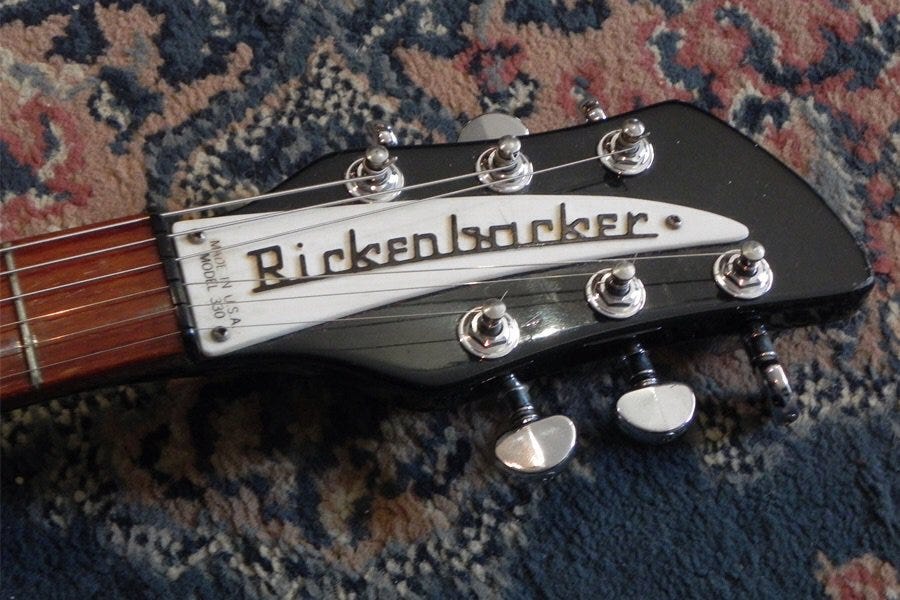
Unfortunately, the Schaller M6 mini tuners (click to learn more) selected as the permanent solution had bushings just as large as the Rotomatics—so they didn’t fit either. This issue gave rise to the fourth major change: the paddle headstock.
The narrow “vintage” headstock in use on all 6-string guitars apart from the 360—which still sported the Gumby headstock—was widened by roughly half an inch to provide the extra room the Schaller bushings required. The new headstock began phasing in across the line in the back half of the year, including on the 360.

Ironically, the paddle headstock looked more like Mr. Gumby himself than the “Gumby headstock” it replaced. The 360 would receive the paddle in December—bringing it back into sync with the rest of the line for the first time since 1971—although it was still equipped with Grover Rotomatics.
The fifth significant change of the year is invisible unless you open the guitar and look at the wiring harness—but immediately obvious once you plug the guitar in. At some point during the year the vintage tone circuit (click to learn more), a high pass filter capacitor that had been standard on all Rickenbacker guitars and basses since the 1950s, was removed. This change gave the bridge pickup higher output with more noticeable bottom end.
Finally—and do not quote me on this—there is the possible sixth major change of 1984. This is likely the year the neck radius changed from the vintage 7.25” to a flatter 10” radius. We know that early 80s guitars retain the old 7.25” radius, and I own a 1986 guitar with a confirmed 10” radius. Given the sheer number of other major changes taking place in 1984, it’s reasonable to suspect that the neck radius change occurred during this same period—even if firm documentation remains elusive.
In October, the 370 and 370/12 would move off the main price list and onto a new Custom Order Price List. The WB option for all four 360 variants also appeared on this list, marking their first official appearance on any price list.

The 360/12BWB—which Hall famously hated—was quietly discontinued at the end of the year. Behind the scenes, a much improved replacement was already in the works, but while a few test mules (click to learn more) from late 1984 have surfaced in the years since, we wouldn’t see the finished product until 1985.
Taken together, the changes of 1984 mark the most profound transformation of the Rickenbacker guitar line since 1973. Under John Hall’s new leadership, long-standing design compromises were addressed, production was modernized, and several features that had defined Rickenbackers since the 1950s quietly disappeared. In many ways the year neatly sums up John Hall’s aspirations for the company: to modernize both the instruments and the manufacturing process in order to meet the needs of contemporary players and improved production efficiency—while still respecting the brand’s heritage and DNA.
1985
After the dramatic changes of 1984, 1985 may seem relatively quiet, but there was a very important addition to the 360 family this year: the 360/12V64.

Modeled after George Harrison’s 1963 360/12OS, this was Rickenbacker’s first serious attempt at a vintage reissue model—as opposed to the somewhat half-hearted 360/12BWB it replaced—and it got a lot right.
Both the body and neck were completely new, with correct period details like 21 frets, square neck heel profile, wider center neck stripe, and full-width poured resin triangle inlays.

The hardware mostly looked the part too, with the hot toaster pickups that had debuted on the B-Series guitars, a trapeze tailpiece, black vintage “KK” knobs, back-painted plexi truss rod cover, and a notable effort to replicate a vintage Fireglo spray pattern.
It wasn’t perfect—the body had modern integrated bracing rather than the original’s x-bracing, the bridge was a stock modern unit, and the tuners were Schaller vintage-style machines that were close to the old Kluson design but not exact replicas.

Still, it was a significant improvement over the B-Series it replaced, and the market responded very positively. It would sell steadily until it was replaced by an ever more historically accurate successor: the 360/12C63.
In January, Schaller M6 Mini tuners replaced Grover Rotomatics on the 360—with one exception that we’ll get to in a minute.

Beginning in late 1984, all models had begun losing the model number stamp on their truss rod covers. You will find 360s produced into the later part of 1985 both with and without the model number stamp, but by the end of the year it was gone for good. The BH/BT guitars we are about to discuss never carried a model number stamp.

Mid-1985 would see a distinct new look for Rickenbacker with the beginning of the BH/BT (black hardware/black trim) era (click to learn more). Midnight Blue, Red, White, Silver, and Mapleglo guitars would come equipped as standard with black finished tuners, pickup covers, bridge covers (but not the bridge itself), strap pins, serial number plates, and black plastic binding, pickguards, and truss rod covers.

While Red, White, Midnight Blue, and Silver guitars came standard with BH/BT, during the BH/BT era—which ran from 1985 to roughly 1998—any color guitar could be custom ordered with black hardware and trim.

Similarly, guitars that came standard with BH/BT could be custom ordered with chrome hardware and white plastics. Such instruments are referred to today as “WT” (for white trim) guitars.

WB guitars could also be ordered with black hardware and black trim, giving them the unwieldy designation of 360WB BH/BT.

At the time Schaller became Rickenbacker’s primary tuner supplier in early 1985, they did not yet offer an M6 Mini tuner in a black finish. As a result, BH/BT guitars were fitted with black Grover Rotomatics until Schaller introduced black M6 Minis in early 1986, making the BH/BT model the last Grover holdouts at Rickenbacker.

While the data is purely circumstantial, it does appear that the black powder-coating process used on the “R” tailpieces may have had some impact on the structural integrity of the tailpiece, as black tailpieces seem to be more prone to breakage than their chrome-plated counterparts.
1986
Two new options were added to the price list in 1986: the stock Higain pickups could be replaced on any guitar with toasters (referred to here as “Vintage Bar pickups”) and the R tailpiece could be replaced by an Accent Vibrato (referred to here as “Vintage RIC Vibrato”).

Guitars so equipped are referred to today as “VP” (vintage pickup) or “VB” (vibrato)—language that was formally added to the price list in 1996. An Accent equipped 360 is therefore a 360VB, not a “335”.
Unlike in their original production run, the Accent option did not include a roller bridge—the standard six-saddle adjustable bridge was left unchanged on guitars ordered with the Accent option.

Guitars with the factory VP option always have the pickups mounted on the standard Higain foam pad. Guitars with toasters mounted on vintage style grommets represent aftermarket modifications, not a factory configuration.
This detail is somewhat difficult to pin down but “early 1986” seems the most likely, although it could be “late 1985”. Since their introduction in 1973, the button top Higain pickup bobbins had been made of a greenish PCB material which—along with the button-tops’ drive-screw polepieces—were then painted black.
Sometime around 1986, however, the bobbin material was changed to a black PCB material, eliminating the need for paint altogether.

1987
A “third pickup” option was added to the price list in 1987. When selected on the 360, the factory officially designated the finished guitar a 370—despite the “370” not currently appearing on the “custom order pricelist”.

1988
The second entry in the Signature Limited Edition (click to learn more) series of guitars was also the first based on the New Style 360. Announced in late 1987, with production beginning in January 1988, the 370/12RM attempted to faithfully recreate both the look and sound of Roger McGuinn’s 1966 360/12-with-an-extra pickup.

Available in Fireglo, Jetglo, and Mapleglo—with Mapleglo sales outnumbering the other two combined by nearly two to one—the 370/12RM was more than a cosmetic homage to McGuinn’s heavily modified original.
First, the 370/12RM was the first New Style 360 to feature a 21-fret neck since 24 frets became the standard in 1973. This required new body tooling, but the 360/12V64’s neck was pressed into service—resulting in an “incorrect” square neck heel. Checkered binding was also used on the back for the first time since 1973.

Next, the 370/12RM was fitted with a 12-saddle adjustable bridge, making it the first Rickenbacker 12-string ever so equipped.

But the 370/12’s biggest party trick was its electronics. A custom-built onboard compressor was installed to replicate the sound McGuinn achieved on early Byrds records through heavy studio compression.

The guitar could also be ordered without the onboard compressor, but the take rate was significantly higher for the compressor-equipped version. The two versions are easy to distinguish—the standard unit used a conventional Rickenbacker five knob control layout while the compressor-equipped version featured five full-sized knobs in an offset layout.


A total of 1000 guitars were produced between 1988 and 1991.
1991
1991 saw the addition of a 6-string counterpart to the 360/12V64: the 360V64. The body and hardware were the same as those used on the 360/12V64, with a neck borrowed from the Rose-Morris 1997 reissue, which had first appeared in 1987 and served as the foundation for the Pete Townshend Signature Limited Edition 1998PT.

The 360V64 would sell alongside the 360/12V64 until their discontinuation in 2001.
A minor but notable change to all Higain equipped guitars—including the 360—occurred around August 1991. A new dual-use pickup bobbin was introduced that could be used for both Higain and toaster pickups, bringing an end to the “fiberboard” button-top Higain era.

1995
Around July, all non-vintage/reissue guitars—including the 360–moved away from the vintage reeded edge strap button that had been used since the late 1950s. It was replaced with a Schaller-style strap lock button, albeit still attached to the Rickenbacker-style bolt rather than a standard wood screw.


While the supplier has changed over the years, the basic design remains in use to this day. The reeded bolt is still used on vintage/reissue guitars, as well as for the mute adjustment screw on bass bridges.
Rickenbacker began moving to CNC manufacturing in early 1995. Prior to CNC machining, bodies and necks were hand cut using templates that wore over time, leading to slight variations from guitar to guitar and year to year as those templates wore and were replaced. Now the same shape would be cut every time.
The 360 would make the transition to CNC in October.
1996
October 1996 saw a step back towards vintage specifications. The three-piece neck’s center walnut “stripe” was widened from 5/16” to 5/8”—returning it to its pre-1973 dimensions.


1999
In mid 1999 Rickenbacker replaced the “hot/12k” toaster pickups with much more historically accurate “scatterwound” toasters, wound to approximately 7.5k ohms, in line with vintage toasters.
These pickups can be easily identified by the corner screws, which changed to slotted heads—matching vintage original toasters. These began appearing on the 360V64 and 360/12V64 in December.

2000
The year 2000 saw the introduction of the second New Style 360 Signature Limited Edition model: the Carl Wilson 360CW and 360/12CW.

Available in six and twelve string versions in both Fireglo and Jetglo, the 360CW was inspired by the 1965 360 played by Wilson in The Beach Boys during the mid 1960s.
One of the most faithful vintage-inspired models to date, the 360CW’s highlights included a 21-fret neck, the newly launched scatterwound toasters, and a flamed maple top approximately 1/8” thinner than current production guitars—much closer to 1960s specifications.

Sadly, the model was replaced posthumously—Wilson had passed away in 1998. The guitar that ultimately reached production was approved by his estate, but was not the model he and John Hall had been developing prior to his death. That unrealized design was based on a 200-Series guitar (click to learn more).
A total of 500 guitars were produced between 2000 and 2001.
2001
While sales of both the 325V63 and 360/12V64 reissue models remained strong, both were discontinued in 2001 in anticipation of the forthcoming C-series replacements. The last 360V64s were produced in August 2001, and the last 360/12V64s in November.

2003
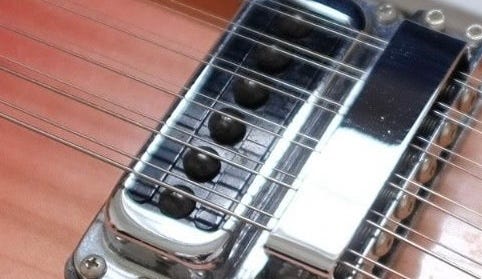
Here’s another minor Higain tweak. In March 2003, shortly after “dimples” (to match the molding marks found on 63 and earlier toasters) were added to the corners of the slots on toaster bobbins to help make the new C-series guitars appear more authentic, Higain pickups got the same treatment. These pickups first began appearing on the 360 mid-year.
2005
As much of an improvement over the 360/12BWB as the 360/12V64 had been, it still wasn’t the exact recreation John Hall ultimately wanted to build. In 2005, Rickenbacker finally delivered that guitar with the 360/12C63.
Work had begun several years earlier to ensure every detail was as faithful as possible. An entirely new body was created, with a more pinched waist and a properly x-braced top—although, in a nod to production efficiency, the x-braces were an integral part of the top rather than individually glued into place

Production was restarted on the vintage “locknut” bridge specifically for this model. The headstock and the truss rod cover were reshaped to match the original. Even the MADE IN U.S.A. print on the truss rod cover was removed in the name of historical accuracy.

In the end, the 360/12C63 accomplished exactly what it set out to do: it delivered the most faithful recreation of George Harrison’s 1963 Rickenbacker 360/12OS the company had ever produced, without sacrificing modern consistency or reliability. It remains in production effectively unchanged to this day.
As elegant a design as the Rickenbacker 12-string headstock is, stringing the sideways tuners has always been a challenge. To address this long-standing player complaint, Rickenbacker began routing the slots for the sideways tuners all the way through the headstock for non-vintage models in 2005.

The change was somewhat divisive—while most praised the improved ease of stringing, many objected to the cosmetic impact, with plenty of players holding both opinions at the same time. The revised headstock first appeared on the 360/12 in June 2005.
2006
In 2006, the Higain pickup gained adjustable button top polepieces for the first time in its history. These updated pickups would first appear on the 330 in April 2006, and this version of the Higain remains in use today, making it the longest-running version of the Higain.
Fun fact: the polepieces can be removed, threaded in from the back, and then installed in a toaster cover. No one will ever know.

2007
In April 2007, there was yet another step back toward vintage specifications. The paddle headstock shrank back to its pre-paddle dimensions—why the Schaller tuners suddenly “worked” on the smaller size headstock remains something of a mystery.

2008
February 2008 saw the return of full-width triangle inlays—and they were neither poured acrylic nor crushed pearl, as had been used in the past. Instead, an acrylic sheet material—similar to the type found on a Gibson Les Paul Standard—was laser cut to shape, and glued in place. This method and material remain in use today.

At the end of 2007 the 6-string 370 was removed from the price list for good. A sizable number were nevertheless produced in 2008 to clear existing orders—including Color of the Year (click to learn more) examples in Blueburst and Amber Fireglo.

While the 370/12 would remain in production for several more years, any 6-string 370 encountered after this point—apart from a small 2018 special run in Satin Autumnglo—has likely had the middle pickup added aftermarket as Rickenbacker last offered the official “add a third pickup” option in 1991.
2009
While a six-string version of the 360/12V64 became a standard offering during the model’s run, the same was not true of the 360/12C63. That said, two special runs of a six-string 360C63 have been produced over the years.
The first took place in 2009 for the Japanese market, commemorating the 60th anniversary of Rickenbacker’s Japanese distributor. A total of 60 guitars were produced—39 in Fireglo and 21 in Jetglo. Most specifications were identical to the 12-string version, with a few notable exceptions.

First, the guitar came with an “R” tailpiece instead of a trapeze. While the neck itself was obviously a six-string neck, this also meant that there was no need to reshape the truss rod cover. And finally, the tuners were—for some reason—Grover Sta-Tite copies instead of the the standard Kluson Deluxe copies.

2011
There is much debate (and misinformation) about the wood Rickenbacker has used for its fingerboards. While the company has always used the generic “rosewood” terminology, the specific genus and species used has changed over time. Consequently, “bubinga” or “African rosewood” are the terms most commonly used to describe the fairly evenly colored, tightly grained, fairly porous and slightly reddish boards historically used.
In late 2011 that changed to chechen, a Caribbean rosewood. Chechen is browner, shows more color variation, and features a more figured and less porous grain—meaning there is much less white grain fill used on the boards. That grain fill had become in turn a defining part of the Rickenbacker board “look” in many players’ eyes


2012
A very subtle change was made to the MADE IN U.S.A. font on all raised letter truss rod covers. The new font is a little squarer and more compact.


2014
What if a 360, but walnut? That question was answered in 2014 with the launch of the 360W and the 360/12W.

Identical to the standard 360 in all respects except woods and finish, the new 360W and 360/12W featured an oil-rubbed walnut body and maple fingerboard.
In April a special run of 50 six-string 360C63s were produced for U.S. retailer Guitar Center. Apart from the six-string neck, all specifications were standard 360/12C63. No six-string 360C63s have been produced since—although the C63 body has been used for multiple special runs featuring unique color and binding combinations.

2017
At the end of 2016 the three-pickup 370 model officially came to an end when the 12-string 370/12 was removed from the price list for good. A small number were nevertheless completed in 2017 to clear existing orders, but any three-pickup 360 bearing a later production date has probably had its third pickup added after the fact.

2020
Whether it was a conscious decision or a COVID supply chain issue that just became permanent, the silver topped knobs that had been standard on all core Rickenbacker models since 1965 began phasing out across the entire line. By August, black “vintage” knobs became standard on the 360.

2021
In the late 2010s/early 2020s, John Hall began stepping away from Rickenbacker’s day-to-day management, leaving the reins increasingly in his son Ben Hall’s hands. As Ben grew more comfortable in the role, he began trying to put his own stamp on the brand.
If we can assign any theme to his approach, it would be “give the people what they want”. Sometimes it’s worked—and sometimes…the loudest voices haven’t been truly representative.
Case in point: in July 2021 fingerboards on all core instruments—including the 360—went from being finished to unfinished. This move would prove to be quite divisive, and in the end it didn’t last long.

2022
In September Rickenbacker quietly began finishing fingerboards once again, bringing a brief and unsuccessful experiment to an end. The 360 was among the first models to revert to the traditional finished board.

2023
Ben’s next significant move would prove far more popular. In January 2023 Rickenbacker introduced one of its most significant changes in years: a return to the vintage-spec 21-fret neck.

They clearly used existing “reissue” tooling, as evidenced by the square neck heel. And like the reissue guitars, the neck was not bound at the bottom, as it had been since the 24-fret neck was introduced.

One “once you see it you can’t unsee it” detail of this new 21-fret version is the teardrop pickguard: the outer edge in the upper guard area is noticeably straighter and less rounded than older 21-fret guitars’ pickguards. Why? Who knows.


And finally, early in the year the primary tuner supplier shifted from Schaller to Gotoh. The new tuners were cosmetically identical to the Schaller M6 minis they replaced, apart from a new “R” logo on the back. The new tuners began appearing on the 360 in April.

2024
At the beginning of the year, the twin single-action truss rods for all guitars apart from the 360/12C63 were replaced by a single, dual-action truss rod.
The change can be identified without removing the truss rod cover by looking at the end of the fingerboard where, for the first time in the 360’s history, no truss rod channel is visible.

Technically speaking, a dual-action rod is far superior to a single-action, so from a pure functionality standpoint this was an upgrade. The change did however bring to an end one of Rickenbacker’s most defining—and longest-lasting—features: the dual truss rod system.
Looking back across more than six decades of production, the story of the Rickenbacker 360 is not one of sudden reinvention, but of constant negotiation—between tradition and modernization, player expectations and production realities, mythology and practicality.
From its origins as a deluxe Capri to its transformation into the definitive “New Style” Rickenbacker, the 360 evolved less through clean generational breaks than through overlapping eras. Vintage features lingered well into the modern age, while forward-looking changes often arrived years before the market fully understood them. The result is a model whose history resists simple categorization—and rewards close inspection.
At various points, the 360 was asked to be many things at once: a flagship, a testbed, a cost-saving measure, a nostalgia piece, and a modern working musician’s instrument. Sometimes those goals conflicted. Sometimes they aligned. When they did—as with the 360/12C63 or the return to 21 frets in the 2020s—the results were among the most successful instruments Rickenbacker has ever produced.
What ultimately sets the 360 apart is not that it remained unchanged, but that it never lost its identity—even as bracing systems, neck profiles, electronics, and production methods came and went. The guitar players recognize today is the product of decades of incremental decisions, compromises, reversals, and refinements, each leaving its mark.
In that sense, the 360 is not just a model—it is a record of how Rickenbacker itself has navigated the balance between heritage and progress. And as long as that tension remains, the 360’s story is unlikely to be finished.
Now I tried to be as complete and correct as possible, but I am sure I missed something or got something wrong. These timelines are always a work in progress—drop your corrections in the comments and I’ll fix them.
Nicely done, Andy. In some ways the history of the evolution of the 360 encompasses most of Rickenbacker history after FC Hall took over in the mid-1950s. It was enjoyable to see photos of about 30 of my guitars used for the illustratons! I built my vintage Rick collection with examples from the mid-'50s to the mid-'70s so the collection could cover that time frame.
Fascinating article! Thanks so much!